Find your calm: How the right yoga practice can ease your unique anxiety
Have you ever wondered why some yoga or relaxation techniques seem to work wonders for your friends but leave you feeling unchanged - or even more restless? If you’re on a journey to manage anxiety through yoga and wellness, you’re not alone in asking this question. Recent research points to a fascinating explanation: the key may lie in the type of anxiety you experience and how you choose to address it.
Let’s break down what this means in a way that’s both science-backed and relatable for anyone who’s rolled out a yoga mat hoping for a little more peace.
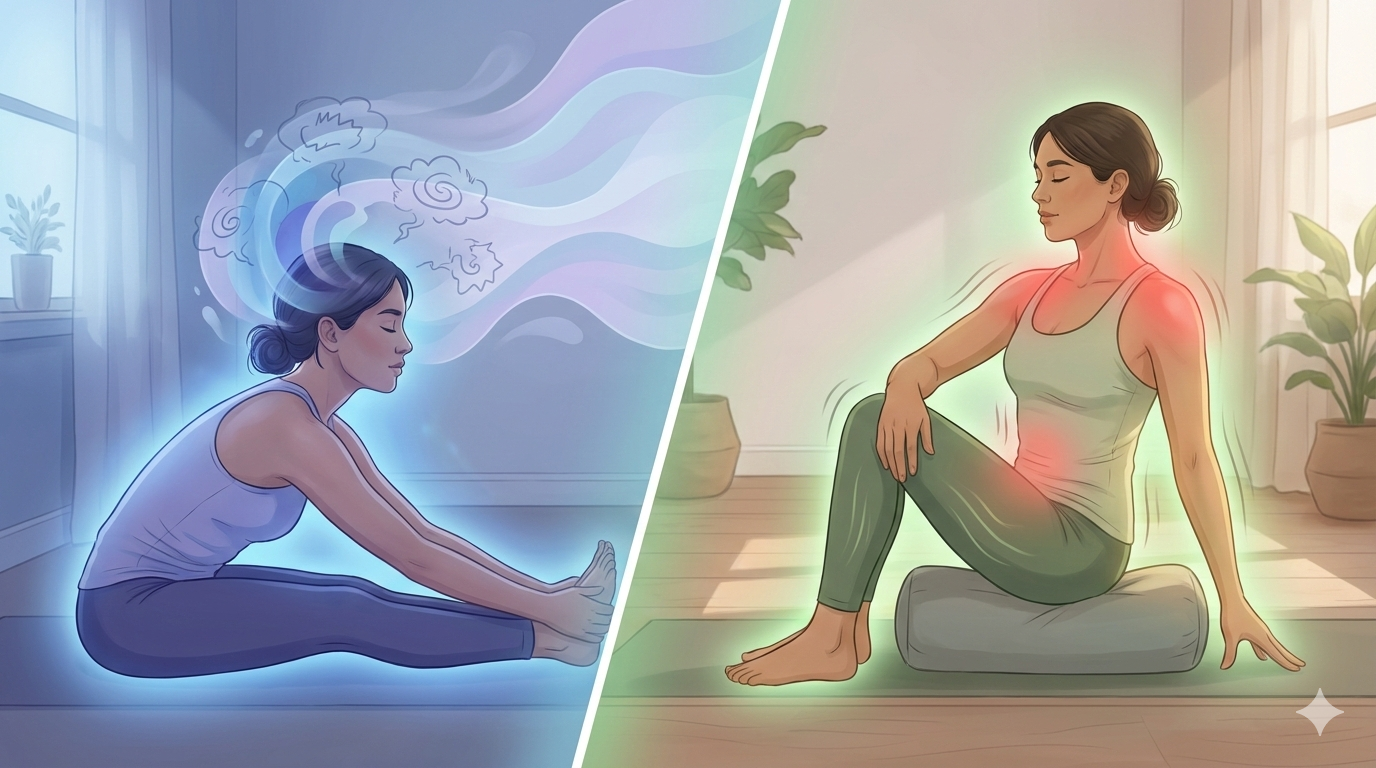
Not all anxiety feels the same. Think about your last anxious moment. Did your heart race and your muscles tense up, or did your mind start spinning with worries and what-ifs? Psychologists describe these as somatic anxiety (felt in the body) and cognitive anxiety (felt in the mind). You might lean more toward one than the other - or even switch between them, depending on the situation. This distinction is more than just interesting trivia; it turns out that how you experience anxiety can influence which relaxation or yoga technique will actually help you most.
A classic study from the University of Winnipeg put this idea to the test. Researchers worked with people who were afraid of snakes (a common fear!) and sorted them into groups based on whether their anxiety was mostly physical or mostly mental. Each group then practiced either Progressive Muscle Relaxation - a technique where you tense and release different muscle groups - or Agni Yoga, a guided visualization that uses imagery of healing light to soothe the mind and body. After a few sessions, participants faced their fear: they were asked to approach a live snake, with their anxiety measured by how close they could get, how anxious they felt, and even their pulse rate.
The results were eye-opening. People whose anxiety showed up in their bodies (think: sweaty palms, tense shoulders) found the most relief with Progressive Muscle Relaxation. This makes sense - by focusing on relaxing the muscles, they directly addressed the part of themselves that felt most anxious. Meanwhile, those whose anxiety was more about racing thoughts and worries got the biggest benefit from Agni Yoga’s calming visualizations. The mental focus and imagery helped quiet their minds, making it easier to face their fears.
This finding introduces a novel perspective for the yoga and wellness community: the effectiveness of relaxation techniques - such as yoga and progressive muscle relaxation - can be significantly enhanced when matched to an individual’s dominant type of anxiety, whether somatic or cognitive. Most relaxation and wellness programs have traditionally treated anxiety as a single, uniform experience. However, evidence now suggests that anxiety is multi-dimensional, and techniques that target the specific dimension of anxiety a person experiences (body or mind) are more effective than a generic, one-size-fits-all approach.
The new insight here is the concept of “personalized relaxation,” where the choice of relaxation or yoga technique is guided by whether a person’s anxiety is more somatic or cognitive. For example, someone with body-based anxiety will benefit most from physical relaxation techniques (like progressive muscle relaxation or body-focused yoga), while someone with mind-based anxiety will see better results from meditative or visualization-based practices (such as Agni Yoga or mindfulness meditation).
This approach opens the door to customized yoga and wellness programs that begin with an assessment of an individual’s anxiety profile. Instructors and practitioners can increase the effectiveness of classes and interventions, help participants achieve faster and more lasting relief from anxiety, and empower individuals to select practices that truly resonate with their personal experience. This personalized relaxation model could inspire yoga studios and therapists to offer tailored sessions based on anxiety type, encourage researchers to investigate which specific yoga styles or mindfulness techniques best suit different psychological profiles, and even motivate app and program developers to create digital tools that recommend practices based on self-reported anxiety symptoms.
So, what does this mean for you, as someone interested in yoga and wellness? It’s a reminder that there’s no “one size fits all” when it comes to finding calm. If you notice that your anxiety is mostly physical, you might find deep relief in yoga practices that emphasize body awareness, like progressive relaxation, body scans, or gentle hatha sequences. If your mind is the main battleground, try guided meditations, visualizations, or specific yogic breathing techniques designed to steady your thoughts.
The key takeaway is this: listen to your body and mind. The more you understand your personal anxiety style, the better you can choose the yoga or relaxation technique that will truly help you unwind. Yoga is a powerful tool for easing anxiety - but it’s even more effective when you tailor your practice to your unique needs. Whether you’re a seasoned yogi or just starting out, experimenting with different techniques can help you discover what brings you the deepest sense of peace. So next time you’re feeling anxious, ask yourself: is it my body or my mind that needs soothing? Your answer could lead you to the perfect practice for your own path to calm.
Tips for yoga practitioners:
Identify your main anxiety type Notice whether anxiety shows up physically (muscle tension, racing heart) or mentally (persistent worries, racing thoughts). Knowing if it’s somatic or cognitive guides your practice.
Match practice to type
Somatic: body-focused methods—progressive muscle relaxation, body scans, gentle yoga for physical release.
Cognitive: mind-focused methods—visualization, guided imagery, mindfulness meditation.
Personalize and reassess Regularly evaluate progress. If one approach isn’t helping, try the other. Tailoring your routine speeds and sustains relief.
Inspired by the research of G.R. Norton & W.E. Johnson, Journal of behavior therapy and experimental psychiatry, 1983
doi: 10.1016/0005-7916(83)90050-2
